
Unless you have worked with one of those mythical, result-driven SEO teams, your experience with SEO must have looked something like…
Negligible results, technical SEO, technical SEO, more technical SEO.
And of course, the avalanche of BS numbers and metrics they make you believe is a report.

Green arrows. Red arrows. Click-through rates. Keyword rankings. Crawl issues.
But the SEO report that lands on your desk is mostly a collection of proxies.
It tells you what happened.
Not why.
Not what changed in your audience’s behavior.
And definitely not what to do next.
Because what most SEO reports ignore entirely are the signals that tell you what your actual visitors did after they landed.
Behavior signals.
And that’s what matters now—for all your AEO, GEO, AIO, and whatever’s left of SEO (since it’s dying again, lol).
The Pretty Privilege of Vanity SEO Metrics
Let me make a wild guess. Absolutely an uneducated guess, I promise.
Your SEO team has pledged solidarity to these few vanity metrics:
- Users – which says nothing about intent.
- Rankings – which mean nothing without conversion.
- Impressions – which don’t equal relevance.
- Bounce rate – which is too shallow to diagnose.
- Pages per session – which can mean discovery or confusion.
All of these are top-of-funnel weather forecasts.
They tell you where the wind is blowing. Not where you are headed.
Back in the day, when Google rewarded you for existing,
If you just had keywords, headings, alt text, and the right meta description, you’d probably show up.
Not anymore.
Now Google, and, by extension, AI Overviews, is doing what good content marketers were always supposed to do:
Evaluate content based on how humans respond to it.
Google doesn’t like to guess anymore.
A spike in impressions won’t tell you if they flinched or leaned in.
A low bounce rate won’t tell you if they understood or just lost.
It doesn’t matter how many keywords you shoved in your H2s or how many backlinks you bought on sketchy digital PR platforms.
It no longer matters that you “answered the question.”
What matters is your user’s behavior that signals belief.
- Did they stay on the page?
- Did they keep scrolling?
- Did they explore another page?
- Did they click on a CTA, nav item, or resource?
- Did they come back later?
How do you track that?
You look at the ugly metrics that no one is tracking (in their defense, for good reason):
- Scroll Depth – How far did they actually engage?
- Average Session Duration – How long did they stay?
- Click Intent Patterns – Where did they go next?
- CTA UTM – Did they act or hover?
- Return Visitors – Did they come back?
And unless your SEO report can answer that,
It’s nothing more than pretty metrics selling you a very pretty lie.
The SEO Metrics that Predict Behavior and Intent
Let’s get our hands dirty.
Here are the actual metrics that help you reverse-engineer belief, interest, and intent and where to find them:
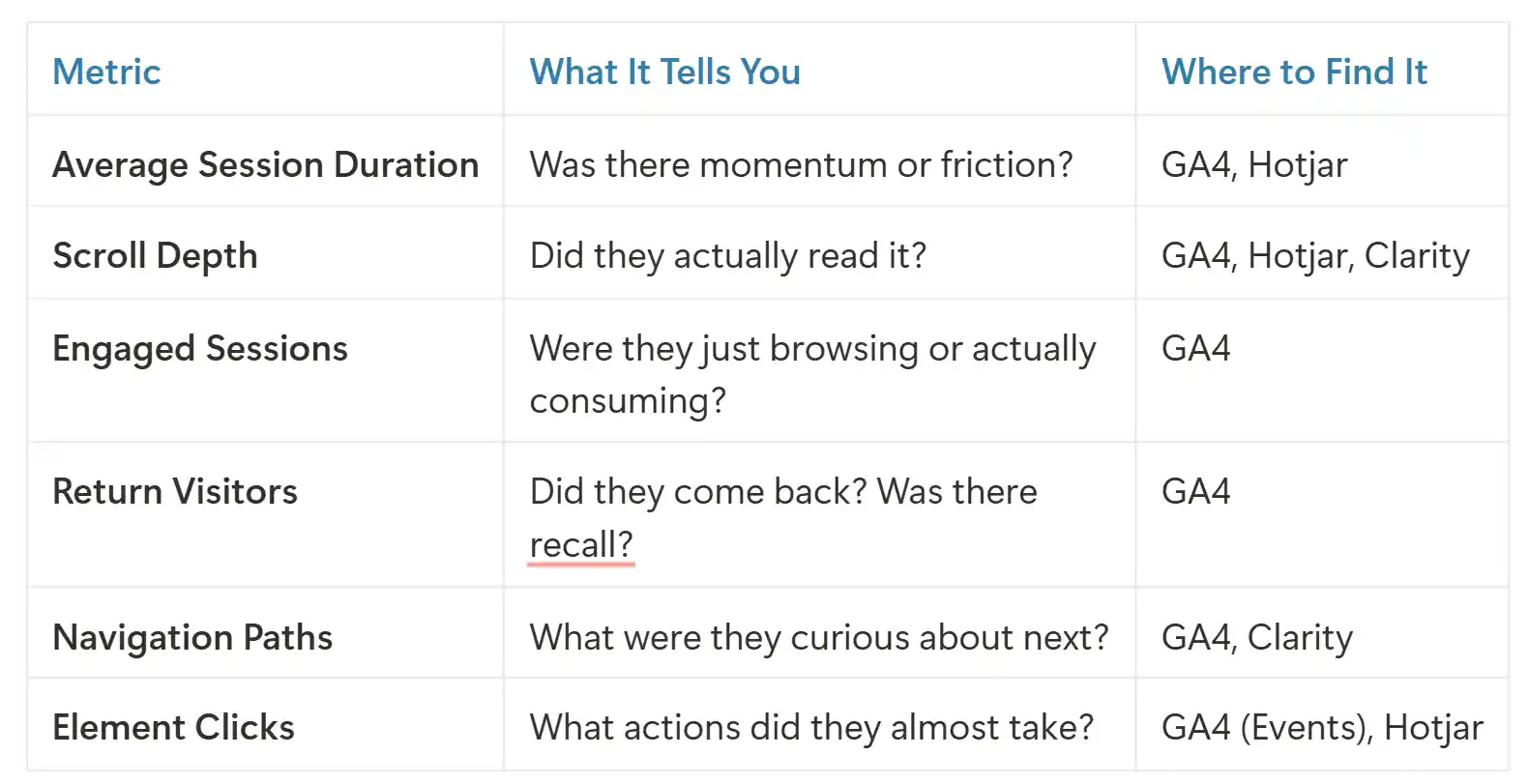
To most SEO peddlers, these are just line items on an SEO reporting dashboard.
But stitched together, they tell a story.
- Where trust began,
- Where friction built,
- Where momentum collapsed.
Because when someone believes…
They seek more. They return. They act.
Why Most Agencies Don’t Track These Metrics
Because it makes them accountable to the story.
It’s easier to say:
“Hey, look! We ranked for 53 more keywords and got 10,000 more impressions.”
Than to admit:
“Only 2 of those blog readers clicked to a product page.”
Traditional SEO reporting favors activity over clarity. And SEO agencies prefer metrics they can manipulate. Not the ones they must answer to.
If your SEO Report doesn’t tell the story of
- Where your users’ belief begins
- Where their trust collapses
- Where conversion momentum drops
Then you don’t have a report. You have a smokescreen.
Behavior Metrics Are Your Best Sales Feedback Loop
Your content is a proxy sales conversation.
- Every scroll is a sign of trust.
- Every skipped section is a question you didn’t answer.
- Every bounce is a prospect walking out of the room.
If your average session duration is dropping, it’s not a technical issue.
It’s an intent issue.
If no one returns to your blog, it’s not a content calendar issue.
It’s a belief failure.
Behavior metrics don’t just improve SEO. They close the feedback loop between strategy, content, and conversion.
If You Want to Fix Your SEO ROI, Fix Your Feedback
It’s not about more dashboards. It’s about better interpretation.
Start treating your SEO metrics like a series of conversations, not outputs.
And track what moves people:
- Attention
- Curiosity
- Clarity
- Consideration
- Belief
- Commitment
- Action
If your content doesn’t generate that,
All your traffic is just… decoration.
A Behavior Funnel That Tells the Truth
Here’s how you should start thinking about your SEO funnel:
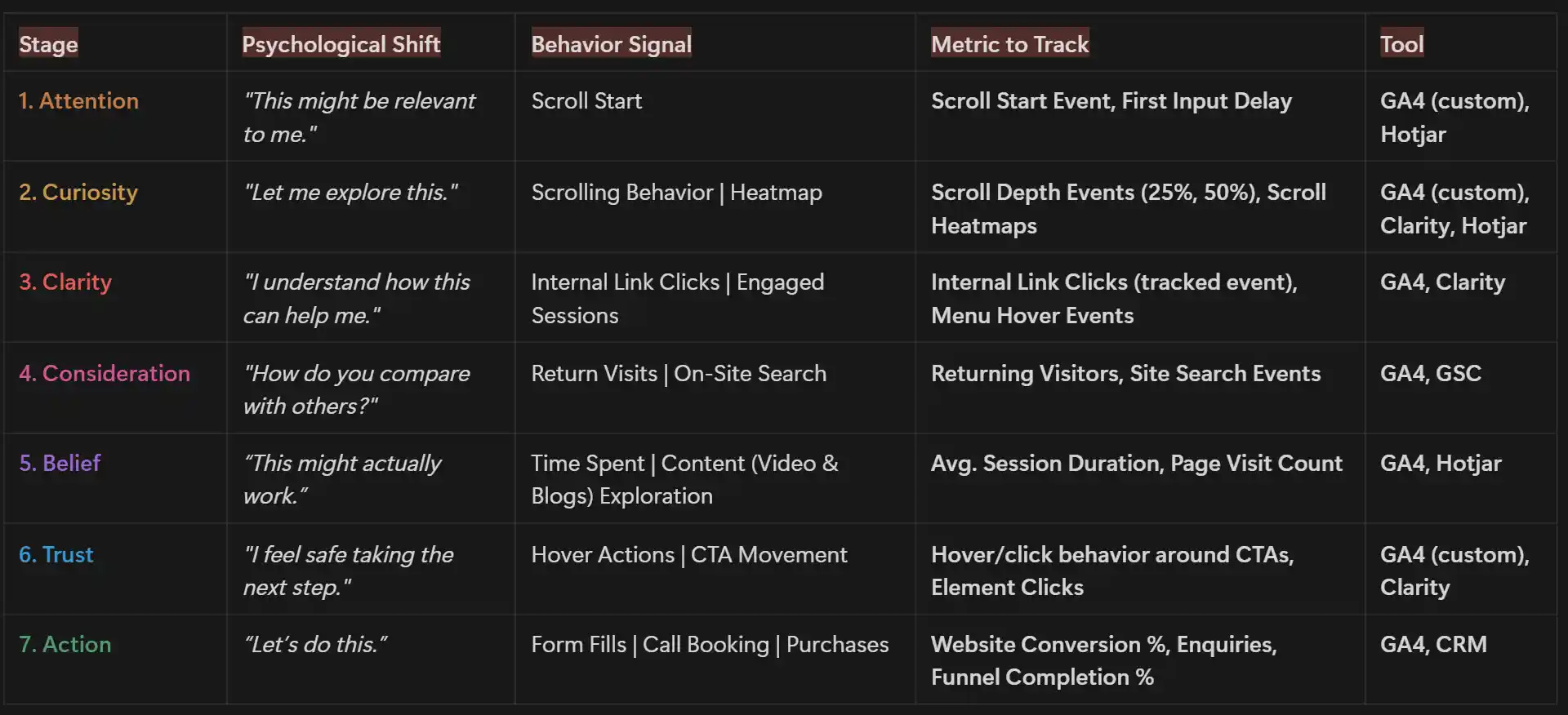
This is the stuff Google is training its LLM models to observe.
Not word count. Not backlinks. Not keyword density.
So next time someone sends you a ranking report, ask:
- ✅Are we measuring actual engagement behavior?
- ✅Do we know what belief looks like in GA4 or GSC?
- ✅Can we isolate the drop-off points that are breaking trust?
- ✅Are we diagnosing sales conversations or just dressing up charts?
When belief is the product, behavior is the proof.
Rankings don’t signal behavior.
- Clicks do.
- Scrolls do.
- Return visits do.
And so, your next SEO strategy shouldn’t start with keywords.
It should start with a single question:
“Why did they stop scrolling?”
PS: Screenshot the funnel above if you’re serious about building a belief-driven SEO engine.

Or DM me, and I’ll show you how to diagnose every stage of your visitor’s journey.