TL;DR: Google’s latest updates didn’t kill SEO—they killed BS content.
Search is no longer about matching keywords. It’s about building belief.
If your content doesn’t collapse doubt, feel real, or move the reader from “maybe” to “sold,” it won’t convert, and soon, it won’t rank either.
Metrics like average session duration now act as proxies for perceived value. Hormozi’s Value Equation maps directly to SEO performance: 👉 Promise + Proof – Delay – Effort = Momentum
The real SEO differentiator in 2025? A narrative system that engineers trust, clarity, and conviction, at scale.
Been a while, crocodiles. This wasn’t a break – just a pause for dramatic effect.
Because something tectonic just happened in search. And no, it’s not “SEO is dead.” (That’s happened 190 times in the last 5 years.)
It’s worse than that.
Google stopped indexing websites.
It started indexing credibility.
And the only way forward now is search experiences that generate belief.
The Fossil Fuel of the Post-SeoCalyptic World
You’ve probably heard it already:
- “Google’s May 2025 update destroyed our rankings.”
- “We lost 60% of organic traffic.”
- “SEO is broken now.”
No. What broke wasn’t SEO.
What broke was the illusion that content = credibility.
That if you said the right words, to the right keywords, in the right structure…
…you’d win. (Oddly like summoning spirits)

That illusion had a good run. But it’s over now.
Because Google finally aligned its algorithm (and AI, of course) with something humans have always used to decide:
“Do I believe this?”
LLMs don’t understand truth. But they pattern-match behavior.
So Google trained its AI to follow what belief looks like: attention, conviction, and action.
Belief—unlike content—isn’t cheap.
And it now fuels both search engines and LLMs.
Belief Layer—The Only Thing Lousy SEO Can’t Engineer
Let’s play this out.
A mid-funnel buyer—problem-aware, comparison shopping, skeptical—lands on your page.
Your headline matches their search. Your H2s look right. Your CTA is visible.
But they bounce in 18 seconds.
Why?
It didn’t collapse time.
It didn’t reduce doubt.
It didn’t build belief.
- You optimized H2s.
- You added comparison tables.
- You copy-pasted your value proposition from ChatGPT.
But their internal monologue still sounded like this:
“Sure, but… will this actually work for me?”
That’s the Belief Gap.
It’s the emotional and cognitive distance between where your reader is when they land… …and where they need to be to take action.
Your job isn’t just to bridge it.
Your job is to collapse it.
Most SEO Agencies Bury this One Metric That Tells the Truth
Over the last decade, the “honorable” SEO industry has taken a liking to fixating on ranking signals, technical SEO, and meta descriptions.
But here’s a question that’ll wreck 80% of SEO reporting:
"What’s your average session duration?"
Not your bounce rate.
Not your CTR.
How long does a visitor stay once they land?
Because if belief is the goal, attention is the currency.
And if your site’s average session duration is under 2 minutes?
You’re not building momentum.
You’re broadcasting noise.
Google now ranks conviction density – not word count.
The algorithm is finally doing what humans always did, asking:
- “Was this written by someone who knows what they’re doing?”
- “Is this content real, or stitched-together AI fodder?”
- “Do I believe them enough to act?”
If your content reads like you wrote it for robots, congratulations.
You’re now invisible to both.
Alex Hormozi’s Unintentional Gift to SEO
Average session duration indicates your visitors’ perceived value of your brand.
Every scroll that doesn’t feel like momentum. Every sentence that doesn’t collapse time. Every benefit that feels vague, buried, or unbelievable.
Tanks your perceived value. And your SEO ROI with it.
Speaking of tanks, here comes a man who couldn’t care less about Google:
Alex Hormozi :)
His Value Equation is a decision-making model that applies far beyond sales offers.
It applies to content.
It applies to SEO.
And it applies to every page on your site.
Value = (Dream Outcome × Perceived Likelihood of Achievement)
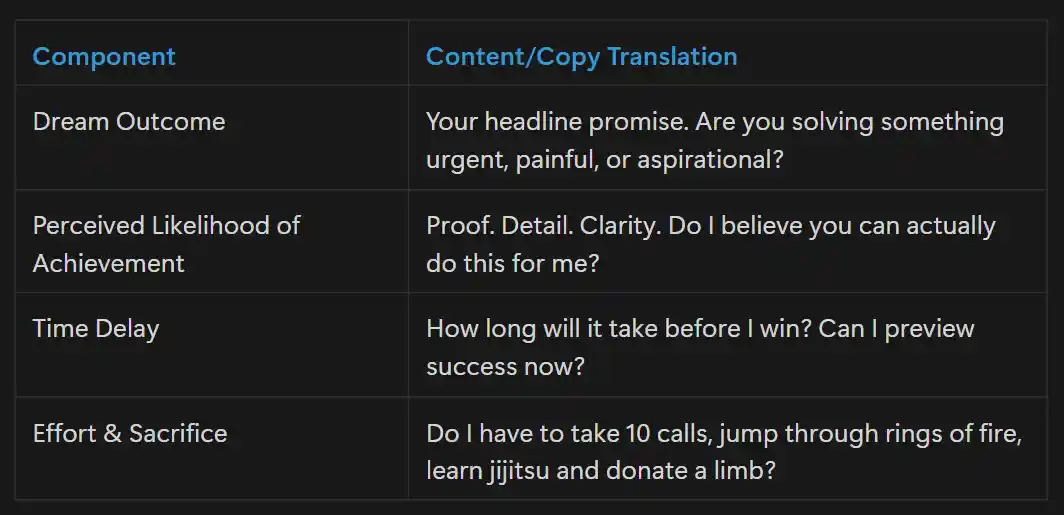
Every element of this equation maps to observable user behavior:
- Dream Outcome = Scroll-start
- Perceived Likelihood = Scroll depth + session duration
- Time Delay = Bounce drop near CTA
- Effort & Sacrifice = Form abandonment + navigation escape
It’s not just theory.
You can track belief like a funnel.
Most SEO content only plays with the first lever.
And without belief, nothing converts.
And soon, nothing ranks either.
If SEO is supposed to create momentum,
Then every page needs to multiply belief and minimize drag.
The Real Reason Why Your Pages Don’t Convert
Let’s make this simple.
The Belief Gap is the distance between what your visitor wants to believe…
It’s why your SEO traffic has high velocity but low intent.
It’s why your total traffic doesn’t tell the whole story, but your session duration does.
It’s why your content feels “informative” but still doesn’t sell.
People don’t believe because you explain.
They believe when you reframe what they already feel.
The 2025 SEO Upgrade from Sitemap to Strategic Narrative
For SEO to work in 2025, you don’t just need a sitemap.
You need a narrative system.
One that starts with tension, unpacks the insight, demonstrates proof, and ends in certainty.
A top-tier SEO asset:
- Opens with tension (empathy > explanation)
- Introduces a new frame (insight > information)
- Injects proof, emotion, timing (momentum > logic)
- Ends with clarity and closure (certainty > options)
It’s a conversion script masquerading as a narrative
Here’s how you know it’s working:
- Your scroll depth increases.
- Your average session duration jumps.
- Your deals close faster.
And most importantly?
You stop being one of many.
You become the only one they believe.
If you want to future-proof your search strategy…
Don’t optimize for keywords.
Optimize for belief.
Run it through this audit:
- ✅ Headline: Does it speak to a dream outcome or just describe a feature?
- ✅ Opening: Does it create tension or start with explanation?
- ✅ Middle: Does it reframe? Or just inform?
- ✅ Proof: Do I believe this is real? Or does it sound stitched together?
- ✅ Close: Do I feel clarity and conviction? Or just “more options”?
Because Google doesn’t just care what you say anymore.
It cares how deeply your reader believes you.
Build a narrative system that takes people from “maybe” to “sold” before they reach the footer.
Because if your content feels like a story they’re living through, their belief deepens.
And belief is what buys.
If you want to rebuild your SEO content like a narrative engine, let’s talk.