Ever been a business owner, marketer, student, or some poor ol’ soul (read: MBA) whose stars were so misaligned that you had to Google the difference between “brand advertising vs direct response advertising”?
Only to be greeted by 99,70,00,000 results in about 0.25 seconds with a variant of the advice, ‘brand advertising is long term, and direct response is a short term’ based on the content writer’s language proficiency and poetic inclination.
Apparently, that vague sh*#’s supposed to solve your big question. A million-dollar question. For many, literally.
Over the last decade, through innumerable interactions with clients, mentors, founders, and marketers better than I, I’ve understood that real-life relationships are the best way to approach this giant of a topic.
How? Strap in. Warning: Some absolutely unsolicited life advice included.

Remind yourself of all the short-term and long-term relationships you have ever had to work to initiate, both platonic and romantic. You’ll realize that you had to approach these connections very differently.
For short-term relationships like casual flings, purchase transactions, or favors, you need to put yourself in the spotlight, grab their attention, and persuade them with logic.
It’s a world of quick and fast transactions that may or may not blossom into the future and, therefore, require much less effort, time, and resources.
This, my friend, is how Direct Response Advertising works.
Meanwhile, for long-term relationships like marriages (or whatever version of agreement fits your sentiment), jobs, or friendships, the process is a long-drawn-out, emotionally powered one.
This is a world of deep emotional connections that grow over a long time and, therefore, require much more effort, time, and resources.
Much like how Brand Advertising plays out.
But understanding the ‘what’ is still half the answer.
The other half is understanding ‘why’ these approaches differ and solving for ‘when’ you need to strategically deploy direct response or brand advertising for small and medium businesses (since big businesses can do whatever the heck they want and still make it work, thanks to money, legacy, or both).
Thankfully, the why is quite simple…. in its complexity.
Direct response and brand advertising differ because there are thousands of people in any given sample group or audience at any given time, and everybody wants something different.
Let me break that down for you.
The general way of “solving” the problem of market competition is by targeting only the people most likely to buy a particular brand’s products and services.
But in most cases, this well-intentioned approach backfires without a well-founded execution strategy.
That’s where the Larger Market Formula framework will come to your aid.
Coined by author and marketer Sabri Suby, the Larger Market Formula breaks down the entire audience of buyers in any market into four key categories:
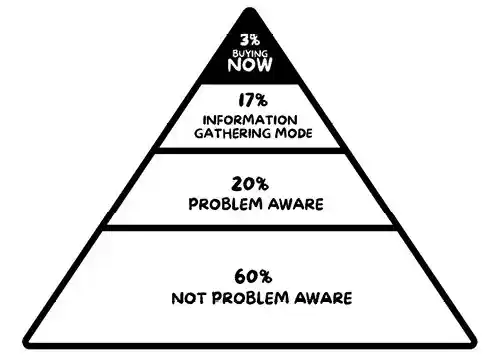
n any given market at any given time, 3% of people are in ‘buying mode’.
If you have ever clicked on an ad shouting, ‘Buy now,’ ‘Download Now,’ ‘Call Today,’ or any other got you taking action without much consideration, then you were among the 3% of the market for that product.
And for these 3%, the conversation IRL may go something like,
“Hey bro, could you please pick me up at 7?” ”Absolutely, yeah!”
“Could you please add that bar of chocolate to my order?” “Sure, Ma’am.”
That’s not hard. A high percentage of the 3% will buy. You might get a few objections and rejections.
But the biggest problem is that all your competitors and their aunts are going hard after that top 3%.

If you split up that 3% of easy customers between you and your competitors, you’ll never have the business growth you want, and that’s anywhere from 10% to 30% a year, depending on your industry. If you like staying in business, that is.
And that’s when you have to look at the rest of the 97%.
They are not sure about what they want yet and are in information-gathering (17%), ‘problem-aware’ (20%), or ‘not problem-aware’ (60%) mode.
Once you understand the larger market formula for Brand and Direct Response Advertising, you can turn even ‘disinterested’ prospects into lucrative customers if you know the right approach and at the right time.
The problem is that most marketers treat every lead like the 3% who are ready to buy now. Direct Response Advertising captures (the 3%), while Brand Advertising nurtures (the 97%).
As you move the 97% of potential customers up the pyramid, you’ll have a new audience ready to take action.
This is why SEO is one of the best channels to capture the intent of the 97% of your market that when they get ready to take action, your business is already out there, kicking and thriving, creating value for the ones still searching for the right solutions to their deepest problems.
Want to know how your brand can leverage Direct Response and Brand Marketing through SEO?
Slide into my InMail :)